
Reviewed · WILDLIFE & ZOO EXPERIENCES
Cairns Aquarium Admission Ticket
Rainforest creatures meet reef giants indoors. Cairns Aquarium gives you a clear, weatherproof way to see Tropical North Queensland’s wildlife, from freshwater streams and ancient rainforest to mangroves, the Great Barrier Reef, and the Coral Sea. I especially like the well-planned journey through local ecosystems and the chance to watch sharks, rays, and coral at close range without a boat trip or snorkel. The daily conservation talks add useful context, too.
The aquarium suits families, reef-bound visitors, and anyone with a spare afternoon in Cairns. I also like the large underwater tunnel and hands-on marine touch tank, which give children something active to do between displays. The main drawback is size: some people will finish in about 1.5 hours, while others who read every plaque and attend talks may stay three hours. At $41.60 per person, value depends on how carefully you explore.
In This Review
- Key points to know before you go
- Why Cairns Aquarium makes a smart rainy-day plan
- A rain drop’s journey from mountains to the Coral Sea
- Freshwater life and rainforest creatures
- Mangroves, coral, and the Great Barrier Reef
- The oceanarium tunnel and deep reef tank
- Shark and ray feeding presentations
- The marine touch tank and sea turtle care
- How long to allow and how to plan your visit
- Is $41.60 good value?
- Who will enjoy this most?
- Cancellation and ticket details worth knowing
- Should you book Cairns Aquarium?
- FAQ
- How much does Cairns Aquarium admission cost?
- How long does a visit to Cairns Aquarium take?
- What are Cairns Aquarium’s opening hours?
- Is Cairns Aquarium open on public holidays?
- What animals and habitats can I see?
- Are talks and feeding shows included?
- Does the ticket include the sea turtle hospital tour?
- Can I use a mobile ticket?
- Can I cancel for a refund?
Key points to know before you go
- Follow one drop of rain: The route links creeks, rivers, rainforest, mangroves, the reef, and the Coral Sea.
- See more than 16,000 animals: The collection focuses on wildlife native to Tropical North Queensland.
- Walk beneath sharks and rays: The oceanarium’s underwater tunnel is one of the most memorable parts.
- Watch live feeding sessions: Shark and ray presentations add movement and useful facts to the displays.
- Try the marine touch tank: You may get a close look at sea creatures in a supervised setting.
- Plan around short opening hours: The aquarium is open from 9:30 a.m. to 3:30 p.m., with last entry at 2:30 p.m.
Why Cairns Aquarium makes a smart rainy-day plan
Cairns weather can change your schedule quickly. A planned reef trip or rainforest outing may not work in heavy rain, rough conditions, or a holiday timetable. The aquarium gives you a reliable indoor alternative, and it still introduces you to many animals associated with the region.
I would not treat it as a replacement for snorkeling on the Great Barrier Reef. You do not get the open water, shifting light, or sense of scale that comes with being at sea. But you do get a close look at animals that are easy to miss while snorkeling, including creatures hidden in deeper water or active only at certain times.
The experience is also useful before a reef excursion. The displays help you recognize fish, rays, sharks, coral, and other marine life later. After snorkeling, it lets you see more species without getting wet, dealing with waves, or feeling motion sick.
More Wildlife Experiences in Cairns
- Cairns Aquarium General Admission Ticket
★ 4.6 · 422 reviews - From Cairns: Rainforest & Nocturnal Wildlife Tour
★ 4.7 · 144 reviews - Solar Whisper Daintree River Crocodile and Wildlife Cruise
★ 5.0 · 1,663 reviews
A rain drop’s journey from mountains to the Coral Sea
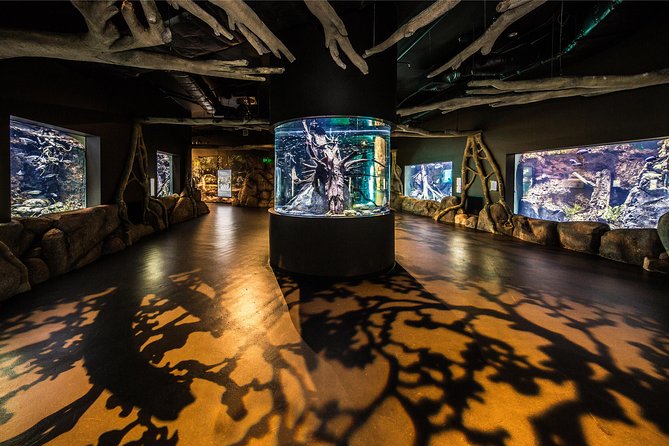
The aquarium’s route follows water rather than simply arranging tanks by animal type. You begin with the movement of rain through creeks and streams, then follow it down rivers and tropical mountain country toward rainforest, mangroves, the Great Barrier Reef, and the Coral Sea.
That order gives the visit a simple story. Freshwater and saltwater are connected, and the health of one system affects the next. For children, it turns a collection of tanks into an easy-to-follow adventure. For adults, it explains why Cairns has such a remarkable mix of land and marine life in one region.
Across more than 70 habitats, you can see animals from the Wet Tropics Rainforest and Great Barrier Reef. The displays include live coral, freshwater species, reptiles, rays, sharks, and animals that are rarely seen in the wild. The setting is compact enough to navigate without a complicated route, which helps when you are visiting with young children.
Some parts may feel more educational than theatrical. That is a plus if you want facts and local context, but visitors looking for a huge city aquarium with endless galleries may find the overall footprint modest.
Freshwater life and rainforest creatures
The early part of the route introduces the environments that feed the reef. Creeks and rivers can seem less glamorous than sharks, but they explain how water moves through Tropical North Queensland and why the region supports so many habitats.
The rainforest displays bring the focus onto land animals and plants associated with the Wet Tropics. The point is not only to show unusual creatures. It is to help you see the connection between mountain streams, forest waterways, coastal wetlands, and the sea.
This section works well for families because the change from freshwater to saltwater is easy to follow. I would take time with the signs rather than rushing toward the larger tanks. The informative plaques help you understand what you are seeing, and the route gives children a reason to compare each habitat.
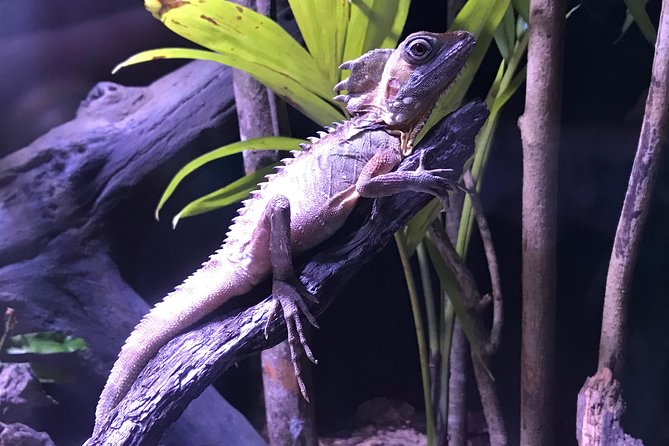
The aquarium also includes reptiles and land animals, so this is not only a fish collection. Exact viewing conditions can vary, and some animals may be less active than others. Still, the regional focus gives the exhibits a stronger sense of place than a general aquarium filled with species from around the world.
Mangroves, coral, and the Great Barrier Reef
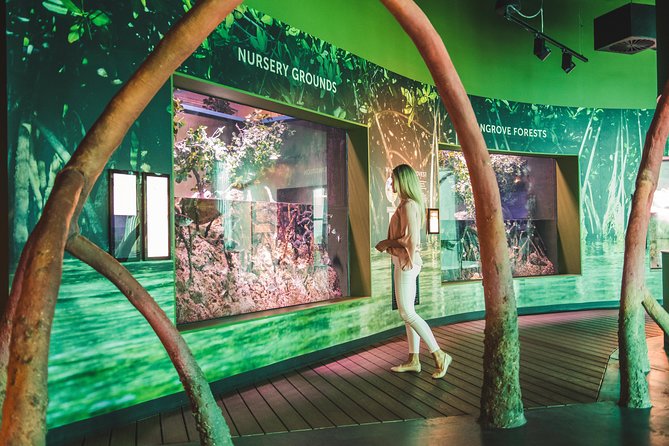
The transition to coastal mangroves is one of the most useful parts of the visit. Mangroves can look plain at first glance, yet they shelter young marine life and form an important link between rivers and the reef.
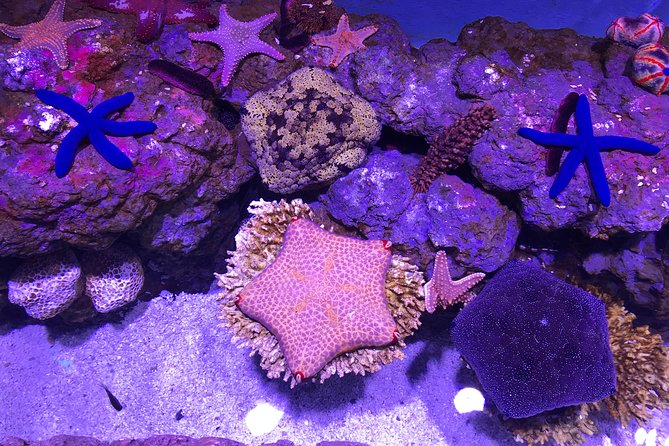
From there, the route moves into coral reef habitats. Live coral displays give you a close, steady view of shapes and colors that can be difficult to study in moving water. You can also pause at the glass and watch fish behavior without needing a mask, fins, or a boat transfer.
The aquarium is particularly valuable for people who have limited mobility in the water, dislike snorkeling, or simply want a calm second look at reef life. It is also a good way to prepare children for a reef trip because they can first learn what they may see in the sea.
Do keep expectations sensible. Glass displays cannot reproduce the size and freedom of the real reef. The aquarium offers clarity and access, not the full outdoor experience.
A completely different kind of day out in Cairns:
- From Cairns: Great Barrier Reef Cruise by Premium Catamaran
★ 4.9 · 3,567 reviews - From Cairns: Self-Guided Kuranda Trip with Train and Skyrail
★ 4.6 · 3,392 reviews - Cairns: Outer Edges of The Great Barrier Reef Scenic Flight
★ 4.9 · 2,912 reviews - Cairns: Daintree Rainforest and Mossman Gorge Tour
★ 4.6 · 2,485 reviews
The oceanarium tunnel and deep reef tank
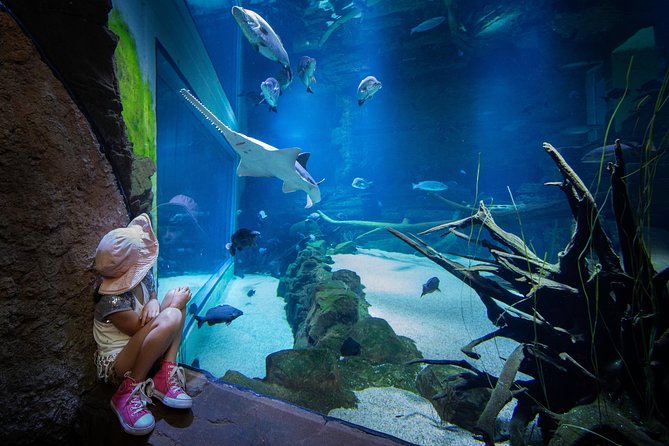
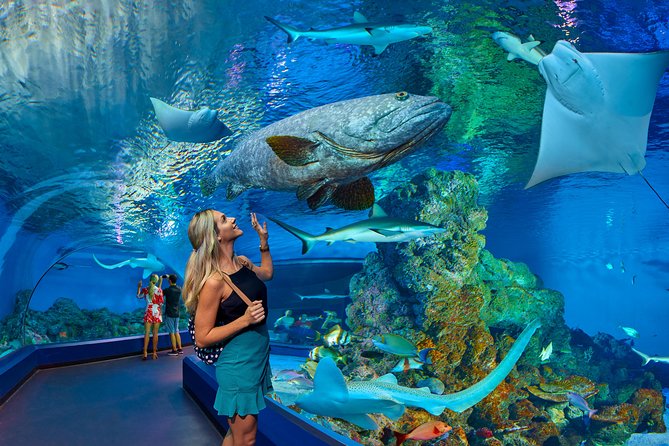
The oceanarium is the visual centerpiece. An underwater tunnel places you below sharks and stingrays as they move overhead and around you. The effect is immediate, especially for children, and it gives you a better sense of how large these animals are than a flat tank can.
This is also one of the easiest areas to enjoy at your own speed. You can walk through, stop for photographs, or sit and watch the animals pass. The clear viewing areas make it possible to study the animals without fighting waves or surface glare.
Cairns Aquarium also presents Australia’s only Deep Reef Tank, described as the tallest deep reef tank in the Southern Hemisphere. That makes this more than a simple collection of small tropical fish tanks. The deeper display shows reef life at a scale and depth that standard shallow exhibits cannot provide.
The shark and predator area receives particular praise for its clean, high-quality displays and helpful signs. If you have limited time, make the oceanarium and deep reef tank priorities.
Shark and ray feeding presentations
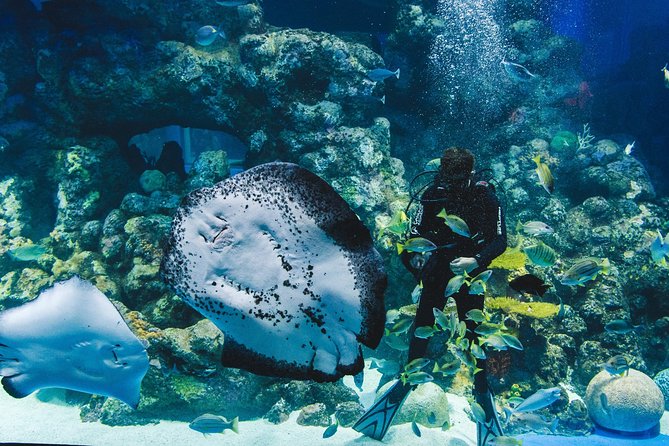
Live ray and shark feeding sessions bring energy to the visit. Feeding time gives you a reason to see the animals moving, rather than simply resting in a corner of the tank.
Daily conservation talks and wildlife presentations are included with admission. Schedules can change, so check the day’s program when you arrive and plan your route around the talks you most want to attend.
The quality of a presentation can depend on the individual speaker and subject. Some talks may feel lively and entertaining, while another may seem more like casual showmanship than a detailed lesson. The strongest sessions connect animal behavior with conservation and the health of the reef.
One especially useful approach is to attend a shark or ray talk after seeing the animals first. You will have a better visual reference for the facts, and children can ask questions based on what they have just watched.
The marine touch tank and sea turtle care
The marine touch tank gives you a more active way to learn. Instead of viewing everything through glass, you may be able to touch selected marine animals under staff direction. It is a popular stop for children and a good break from walking through galleries.
Follow the instructions carefully and keep your hands gentle. The point is respectful contact, not handling animals for entertainment.
The sea turtle hospital is another meaningful part of the aquarium experience. A separate turtle hospital tour may be available as an additional activity, and it has been a highlight for some visitors. The focus is rehabilitation and the role of Australia in protecting sea turtles.
Because the standard ticket information specifically includes the marine touch tank but does not list the turtle hospital tour as part of general admission, check whether that tour requires an extra booking or fee. If turtle conservation matters to you, it is worth asking about when you arrive.
How long to allow and how to plan your visit
The advertised visit time is about two to three hours. Your pace will make a real difference.
If you move quickly and skip presentations, you might see the main displays in around 1.5 hours. If you read the plaques, stop at the tunnel, attend feeding sessions, watch conservation talks, and take breaks, three hours is reasonable.
The aquarium operates every day of the year, including public holidays. Opening hours are 9:30 a.m. to 3:30 p.m., with last entry at 2:30 p.m. That is a fairly narrow window, so do not leave this activity until late afternoon.
I would arrive earlier rather than later if you want to catch talks and take your time. School holidays can bring heavier admission lines. A mobile ticket confirms your purchase and guarantees entry, but it does not necessarily mean faster admission. The aquarium has clarified that prepaid tickets are an alternative way to buy admission, not a promise of priority processing.
That distinction matters. If you arrive during a busy period, allow patience at the entrance even with a ticket on your phone.
Is $41.60 good value?
At $41.60 per person, this is not a quick, cheap stop. It becomes better value if you use the full two to three hours and attend the included talks and feeding session.
The price covers the aquarium’s major habitats, oceanarium tunnel, deep reef tank, touch tank, conservation talks, and animal care. You are paying for a self-guided attraction that can fill a wet morning or afternoon without transport planning.
Families should calculate the total cost carefully, especially if several people are paying full price. The aquarium may offer concession or pensioner rates, and some accommodation providers have supplied visitors with discounts, but availability depends on the offer at the time of your visit.
The compact design can be a benefit. You do not spend the day marching through a huge building, and there are benches where you can rest. It can also feel like less for your money if you expect a full-day attraction.
Who will enjoy this most?
I would recommend Cairns Aquarium for:
- Families with children who like animals and hands-on exhibits
- People seeking an indoor plan during poor weather
- Reef visitors who want to learn more about marine life
- Anyone who dislikes snorkeling, boats, or motion sickness
- Adults who appreciate regional ecology and conservation
- Visitors with a spare morning before hotel check-in
It may be less satisfying if you want a large international aquarium with many unrelated exhibits. The focus here is firmly on Tropical North Queensland, and the experience is designed around local connections rather than sheer size.
The aquarium is near public transportation, service animals are allowed, and most people can take part. Children must be accompanied by an adult. Food and drinks are not included, and transportation to or from the aquarium is also your responsibility.
Cancellation and ticket details worth knowing
Free cancellation is available if you cancel at least 24 hours before the experience start time. A cancellation made inside that window is not refunded, and changes made less than 24 hours before the start time are not accepted.
Your confirmation is issued at booking, and the ticket is mobile. Keep the operating hours in mind when selecting your day, since the last entry time is 2:30 p.m.
Should you book Cairns Aquarium?
I would book it if you want a well-presented, local, family-friendly indoor attraction. The underwater tunnel, shark and ray feeding, live coral, touch tank, and rainforest-to-reef route give you plenty to see in a focused visit.
I would not book it expecting a substitute for the Great Barrier Reef itself. Instead, think of it as a useful companion to a reef trip, or a strong backup when weather disrupts your plans. Arrive early, check the talk schedule, allow two to three hours, and do not assume a prepaid mobile ticket means a faster queue.
For families, first-time Cairns visitors, and anyone who wants to understand how rainforest waterways connect with the reef, the ticket is a sensible buy.
FAQ
How much does Cairns Aquarium admission cost?
The listed admission price is $41.60 per person.
How long does a visit to Cairns Aquarium take?
The expected visit lasts about two to three hours. A faster visit may take around 1.5 hours, while a slower visit with talks and detailed reading can take closer to three hours.
What are Cairns Aquarium’s opening hours?
The aquarium is open from 9:30 a.m. to 3:30 p.m. every day. Last entry is at 2:30 p.m.
Is Cairns Aquarium open on public holidays?
Yes. Cairns Aquarium is open 365 days a year, including public holidays.
What animals and habitats can I see?
You can see more than 16,000 marine and land animals from Tropical North Queensland across more than 70 habitats. The route includes rainforest, freshwater, mangrove, Great Barrier Reef, and Coral Sea environments.
Are talks and feeding shows included?
Yes. The admission includes daily conservation talks and presentations, along with live ray and shark feeding shows.
Does the ticket include the sea turtle hospital tour?
The general admission inclusions list the marine touch tank but does not list the turtle hospital tour. Check with Cairns Aquarium about availability and any additional charge.
Can I use a mobile ticket?
Yes. The experience provides a mobile ticket, and confirmation is received at the time of booking.
Can I cancel for a refund?
Yes, if you cancel at least 24 hours before the experience start time. Cancellations made less than 24 hours before the start time are not refunded.
Just added around Cairns
- Cairns: Great Barrier Reef Pontoon with Water Activities★ 4.8 · 132 reviews
- From Cairns: Frankland Island All-Inclusive Day Tour★ 4.7 · 132 reviews
- Cairns: Ocean Spirit Great Barrier Reef Full Day Tour★ 4.8 · 138 reviews
- From Cairns: Rainforest & Nocturnal Wildlife Tour★ 4.7 · 144 reviews
- N. Queensland: Kuranda Rainforest Full-Day Tour★ 4.5 · 165 reviews
- From Cairns: Chillagoe Caves and Outback Full-Day Tour★ 4.6 · 176 reviews
- Kuranda, Skyrail & Gold Class Train from Cairns★ 4.7 · 177 reviews
- Cairns: Sunset River Cruise with Snack and Drinks★ 4.7 · 185 reviews
Wildlife & Zoo Experiences, compared.

Penguin Parade, & Wildlife Encounters Eco Tour from Melbourne
Read our review →
Blue Mountain Small Group Scenic World, Wildlife, Waterfall
Read our review →
Melbourne Great Ocean Rd Reverse Tour London Bridge Wildlife
Read our review →
Litchfield National Park and Jumping Crocodile Cruise
Read our review →
Blue Mountains Adventure: Scenic World, Zoo & Koala Photo
Read our review →
Solar Whisper Daintree River Crocodile and Wildlife Cruise
Read our review →
Browse the lists this tour appears in